How real-time virtual replicas are revolutionizing robot design, deployment, and optimization while reducing costs and eliminating downtime
In a BMW manufacturing plant in Munich, engineers can predict when a robotic welding arm will fail three weeks before it happens. They can test new production line configurations without stopping operations, optimize robot movements to reduce energy consumption by 15%, and train AI systems on millions of virtual scenarios that would take decades to encounter in the real world. The secret? Digital twins—sophisticated virtual replicas that mirror every aspect of their physical robotic counterparts in real-time.
Digital twin technology represents one of the most significant advances in robotics engineering, fundamentally changing how organizations design, deploy, optimize, and maintain robotic systems. By creating dynamic, data-driven virtual models that continuously sync with physical robots, engineers can transcend the traditional limitations of physical testing and unlock unprecedented levels of efficiency, reliability, and innovation.
Understanding Digital Twins in Robotics
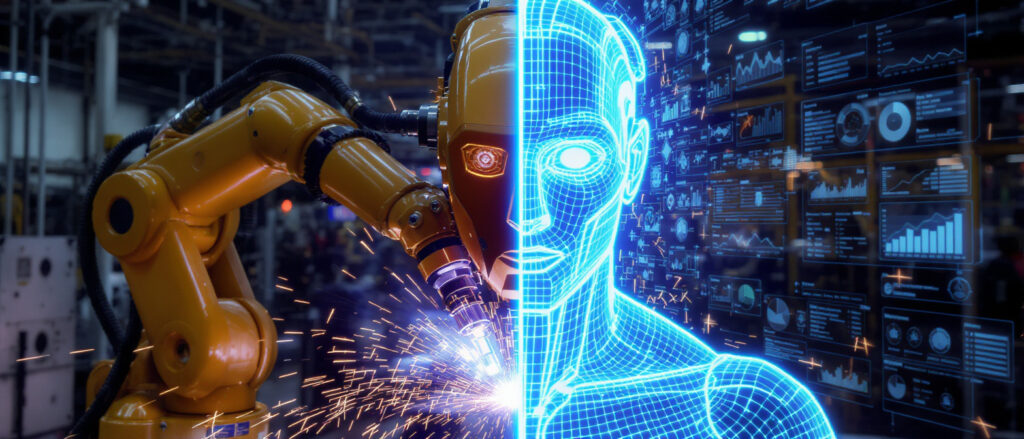
A digital twin is far more than a 3D model or simulation—it’s a living, breathing digital replica that maintains a continuous bi-directional relationship with its physical counterpart. In robotics, digital twins integrate real-time sensor data, environmental conditions, operational parameters, and performance metrics to create virtual models that accurately reflect every aspect of robot behavior, wear patterns, and operational context.
The sophistication of modern digital twins goes beyond simple mirroring. These systems incorporate physics-based modeling, machine learning algorithms, and predictive analytics to not only show what’s happening now, but forecast future states, identify optimization opportunities, and enable “what-if” scenario testing that would be impossible or prohibitively expensive in the physical world.
The Three Pillars of Robotic Digital Twins
Physical Entity: The actual robot with its sensors, actuators, controllers, and environmental interfaces. This includes not just the robot itself, but its complete operational context—conveyor systems, safety barriers, human operators, and environmental conditions.
Virtual Entity: The digital replica incorporating geometric models, physics simulations, behavioral algorithms, and predictive models. This virtual representation must capture not only the robot’s mechanical properties but also its control software, sensor characteristics, and interaction patterns.
Bidirectional Data Flow: Continuous, real-time information exchange between physical and virtual entities. Sensors feed operational data to the digital twin while the virtual model provides insights, predictions, and optimization commands back to the physical system.
The Technical Architecture
Data Integration and Sensor Fusion
Modern industrial robots generate tremendous amounts of data—position encoders, force sensors, vision systems, temperature monitors, vibration detectors, and power consumption meters create continuous streams of information. Digital twins must process and correlate this multi-modal data in real-time to maintain accurate virtual representations.
Time-Series Data Management: Advanced time-series databases optimized for high-frequency sensor data, capable of handling millions of data points per second while maintaining query performance for real-time analysis.
Edge Computing Integration: Local processing capabilities that filter and pre-process sensor data at the robot level, reducing bandwidth requirements and latency while ensuring critical safety decisions don’t depend on cloud connectivity.
Data Quality Assurance: Sophisticated algorithms for detecting sensor drift, identifying outliers, and maintaining data integrity even when individual sensors fail or provide inconsistent readings.
Physics-Based Modeling
Digital twins employ multiple levels of physical modeling to accurately represent robot behavior:
Kinematic Models: Mathematical representations of robot motion, joint relationships, and workspace boundaries. These models calculate precise positions, velocities, and accelerations for every component throughout the robot’s operating envelope.
Dynamic Models: Complex simulations incorporating mass distribution, inertia, friction, and external forces. These models predict how robots will respond to different loads, speeds, and acceleration profiles, enabling optimization of movement patterns for energy efficiency and mechanical stress reduction.
Thermal Models: Temperature distribution modeling that tracks heat generation in motors, electronics, and mechanical components. These models predict thermal expansion effects, cooling requirements, and thermal-induced wear patterns.
Wear and Degradation Models: Sophisticated algorithms that track component wear based on operational history, environmental conditions, and mechanical stress patterns. These models enable predictive maintenance by forecasting when components will reach end-of-life conditions.
Machine Learning Integration
Modern digital twins incorporate multiple AI and machine learning technologies:
Anomaly Detection: Unsupervised learning algorithms that establish baseline operating patterns and identify deviations that may indicate developing problems, performance degradation, or operational inefficiencies.
Predictive Maintenance Models: Machine learning systems trained on historical failure data, sensor patterns, and maintenance records to predict component failures, optimal maintenance timing, and replacement part requirements.
Performance Optimization: Reinforcement learning algorithms that continuously experiment with operational parameters in the virtual environment to identify more efficient movement patterns, energy consumption profiles, and throughput optimizations.
Digital Twin Calibration: Continuous learning systems that adjust virtual model parameters based on real-world performance data, ensuring the digital twin maintains accuracy as physical systems age and environmental conditions change.
Real-World Applications and Use Cases
Predictive Maintenance: Beyond Scheduled Service
Traditional robotic maintenance follows fixed schedules based on operating hours or calendar time, often resulting in unnecessary service or unexpected failures. Digital twin-enabled predictive maintenance monitors actual component condition and predicts failures based on real usage patterns and environmental conditions.
Case Study: A major automotive manufacturer implemented digital twins for their robotic paint spraying systems. By monitoring vibration patterns, paint flow rates, and atomizer wear characteristics, their digital twin system predicts spray gun maintenance needs with 94% accuracy, reducing unplanned downtime by 67% while extending component life by 23% through optimized maintenance timing.
The system continuously analyzes thousands of parameters—motor current signatures, bearing vibration frequencies, hydraulic pressure variations, and paint viscosity measurements—to build comprehensive health models for each robot. When the digital twin predicts a component will fail within the next maintenance window, technicians can proactively replace it during scheduled downtime rather than experiencing emergency failures during production.
Virtual Commissioning: Risk-Free Deployment
Traditional robot deployment requires extensive physical testing, programming, and debugging on the production floor, often resulting in weeks of production disruption and substantial costs when problems arise. Digital twins enable complete virtual commissioning, where entire robotic systems can be programmed, tested, and optimized in virtual environments before physical installation.
Implementation Process: Engineers create detailed digital twins of the complete production environment—robots, conveyor systems, safety devices, product variations, and even human operator patterns. Robot programs are developed and tested entirely in the virtual environment, with millions of operational scenarios tested in compressed time.
This approach has revolutionized robotics deployment at companies like Siemens, where complex robotic assembly lines are fully programmed and optimized in virtual environments. Physical installation becomes simply a matter of downloading pre-tested programs to physical robots, reducing commissioning time from weeks to days while virtually eliminating startup problems.
Performance Optimization: Continuous Improvement
Digital twins enable continuous optimization of robotic operations by testing improvements in virtual environments before implementing them physically. This capability is particularly valuable for high-speed manufacturing operations where even small efficiency gains translate to significant cost savings.
Energy Optimization: Digital twins can test thousands of different movement profiles to identify the most energy-efficient paths and acceleration patterns. By optimizing robot movements in virtual environments, manufacturers achieve 10-20% energy savings without impacting cycle times or product quality.
Throughput Maximization: Virtual testing of different product flow patterns, robot coordination strategies, and buffer management approaches enables identification of bottlenecks and optimization opportunities that would be impossible to test physically without disrupting production.
Quality Improvement: Digital twins can simulate the impact of different operational parameters on product quality, enabling optimization of robot movements, process timing, and environmental conditions to minimize defects and improve consistency.
Training and Skill Development
Digital twins provide safe, cost-effective environments for training robot operators, maintenance technicians, and engineers without risk to expensive equipment or production disruption.
Operator Training: Virtual reality interfaces connected to digital twins allow operators to practice complex procedures, emergency responses, and troubleshooting scenarios in realistic environments. Trainees can experience rare failure modes and practice recovery procedures that might occur only once every few years in real operations.
Engineering Education: Digital twins provide engineering teams with comprehensive testing environments for developing and validating new automation concepts, robot programming techniques, and system integration approaches.
Implementation Challenges and Solutions
Data Quality and Sensor Reliability
Digital twins are only as accurate as the data they receive, making sensor quality and reliability critical success factors. Industrial environments present numerous challenges to sensor performance:
Environmental Interference: Manufacturing environments often include electromagnetic interference, temperature extremes, vibration, and contamination that can affect sensor accuracy. Digital twin systems must incorporate sensor health monitoring and data validation algorithms to maintain accuracy despite challenging conditions.
Sensor Degradation: Sensors themselves wear out and drift over time, potentially corrupting digital twin accuracy. Advanced systems incorporate multiple redundant sensors and cross-validation algorithms to detect and compensate for sensor degradation.
Data Synchronization: With hundreds of sensors providing data at different frequencies and with varying latencies, maintaining synchronized data sets for accurate digital twin updates requires sophisticated time synchronization and data correlation algorithms.
Computational Complexity and Real-Time Requirements
Comprehensive digital twins require enormous computational resources, particularly when incorporating complex physics simulations, machine learning algorithms, and real-time optimization. Organizations must balance model fidelity with computational constraints and real-time performance requirements.
Hierarchical Modeling: Successful implementations use multi-level modeling approaches—detailed physics models for critical components and simplified models for less critical elements. This approach maintains accuracy for important predictions while keeping computational requirements manageable.
Adaptive Detail Levels: Dynamic systems that increase model detail when anomalies are detected or optimization opportunities are identified, while running simplified models during normal operations to conserve computational resources.
Edge-Cloud Hybrid Architectures: Critical real-time functions run on edge computing systems co-located with robots, while complex analytics and optimization run in cloud environments with results periodically synchronized to edge systems.
Integration with Legacy Systems
Many organizations operate mixed environments with legacy robots and modern systems, creating integration challenges for digital twin implementations.
Retrofit Sensing: Adding sensors and communication capabilities to legacy robots often requires creative engineering solutions and careful integration to avoid disrupting existing operations.
Protocol Translation: Digital twin systems must communicate with robots using different communication protocols, data formats, and update frequencies, requiring sophisticated protocol translation and data normalization capabilities.
Phased Implementation: Successful digital twin deployments often use phased approaches, starting with new equipment and gradually extending coverage to legacy systems as retrofit opportunities arise.
Economic Impact and Return on Investment
Quantifiable Benefits
Organizations implementing comprehensive digital twin systems report significant measurable benefits:
Maintenance Cost Reduction: Predictive maintenance enabled by digital twins typically reduces maintenance costs by 25-40% while improving equipment availability by 10-15%.
Energy Savings: Optimization of robot operations through digital twin analysis commonly achieves energy reductions of 10-20%, with some applications achieving savings over 30%.
Quality Improvements: Better understanding of process variations and optimization of operating parameters typically improve product quality metrics by 15-25% while reducing scrap rates.
Deployment Speed: Virtual commissioning reduces new system deployment time by 30-50% while virtually eliminating startup problems and associated costs.
Strategic Value Creation
Beyond direct cost savings, digital twins create strategic value through enhanced organizational capabilities:
Innovation Acceleration: The ability to test new concepts and configurations in virtual environments dramatically accelerates innovation cycles and reduces the risk of new technology adoption.
Operational Agility: Digital twins enable rapid response to changing market conditions, product variations, and operational requirements through virtual testing and optimization.
Knowledge Capture: Digital twin systems create comprehensive digital records of operational knowledge, best practices, and optimization strategies that become valuable organizational assets.
Competitive Advantage: Organizations with mature digital twin capabilities can respond more quickly to market changes, achieve higher operational efficiency, and offer more reliable customer service than competitors using traditional approaches.
Future Developments and Emerging Trends
Autonomous Digital Twins
The next generation of digital twin technology will incorporate autonomous decision-making capabilities, moving beyond monitoring and prediction to active optimization and self-healing:
Self-Optimizing Systems: Digital twins that continuously experiment with operational parameters and automatically implement improvements when virtual testing demonstrates benefits.
Autonomous Maintenance Scheduling: Systems that not only predict maintenance needs but automatically schedule maintenance activities, order replacement parts, and coordinate with production schedules to minimize disruption.
Adaptive Learning: Digital twins that continuously learn from operational experience and automatically update their models to improve accuracy and prediction capabilities.
Ecosystem-Level Digital Twins
Current digital twin implementations typically focus on individual robots or production lines. Future systems will create comprehensive digital twins of entire manufacturing ecosystems:
Supply Chain Integration: Digital twins that model entire supply chains, enabling optimization of material flows, inventory levels, and production scheduling across multiple facilities and suppliers.
Cross-System Optimization: Comprehensive models that optimize interactions between robotic systems, human workers, material handling equipment, and quality control systems to maximize overall operational efficiency.
Facility-Wide Modeling: Complete digital representations of manufacturing facilities that enable optimization of energy systems, environmental controls, safety systems, and space utilization in conjunction with robotic operations.
Human-Robot Collaboration Enhancement
Advanced digital twins will better model human-robot interactions, enabling more sophisticated collaborative systems:
Human Behavior Modeling: Digital twins that incorporate models of human operator behavior, enabling optimization of human-robot collaboration and prediction of safety risks.
Adaptive Collaboration: Systems that automatically adjust robot behavior based on real-time monitoring of human operators, optimizing productivity while maintaining safety.
Training Integration: Digital twins connected to augmented reality systems that provide real-time guidance and training to human operators working alongside robots.
Implementation Best Practices
Strategic Planning and Roadmap Development
Successful digital twin implementations require careful strategic planning and phased deployment approaches:
Use Case Prioritization: Starting with applications that provide clear, measurable benefits—typically predictive maintenance and virtual commissioning—before expanding to more complex optimization and autonomous operation use cases.
Technology Infrastructure Assessment: Evaluating existing IT infrastructure, networking capabilities, and data management systems to identify requirements for digital twin support.
Skills Development: Building organizational capabilities in data analytics, machine learning, and digital twin technologies through training, hiring, and partnerships with technology providers.
Data Governance and Security
Digital twin systems handle enormous amounts of sensitive operational data, requiring robust governance and security frameworks:
Data Quality Management: Establishing processes and systems for ensuring data accuracy, completeness, and consistency across all digital twin applications.
Cybersecurity: Implementing comprehensive security measures to protect digital twin systems from cyber threats while maintaining operational availability and performance.
Privacy and Compliance: Ensuring digital twin implementations comply with relevant regulatory requirements and privacy standards while enabling necessary data sharing and analysis.
Organizational Change Management
Digital twin technology represents a significant shift in how organizations approach robotics and manufacturing operations:
Cultural Adaptation: Helping organizations transition from reactive, experience-based decision making to proactive, data-driven approaches enabled by digital twin insights.
Process Integration: Modifying existing maintenance, operations, and engineering processes to effectively leverage digital twin capabilities and insights.
Performance Measurement: Developing new metrics and key performance indicators that reflect the enhanced capabilities and strategic value created by digital twin implementations.
Conclusion: The Digital-Physical Convergence
Digital twin technology in robotics represents more than a technological advancement—it’s a fundamental transformation in how organizations understand, optimize, and operate robotic systems. By creating dynamic bridges between physical and virtual worlds, digital twins enable unprecedented levels of insight, prediction, and optimization that were previously impossible.
The organizations that will thrive in the next decade of industrial automation are those that recognize digital twins not as a technology add-on, but as a core capability that fundamentally changes how they approach robotics. From design and deployment through optimization and maintenance, digital twins touch every aspect of the robotics lifecycle, creating new possibilities for efficiency, reliability, and innovation.
As digital twin technology continues to mature and become more accessible, we can expect to see rapid adoption across industries. The key to success lies in understanding that digital twins are not just about technology—they’re about creating new ways of thinking about and interacting with robotic systems that unlock value that was previously hidden in the complexity of physical operations.
For organizations beginning their digital twin journey, the message is clear: start with focused applications that demonstrate clear value, build organizational capabilities and data infrastructure, and prepare for a transformation that will fundamentally change how robotics contributes to business success. The future of robotics is not just physical—it’s digital, and organizations that embrace this convergence will lead the next era of industrial automation.
About The Author