

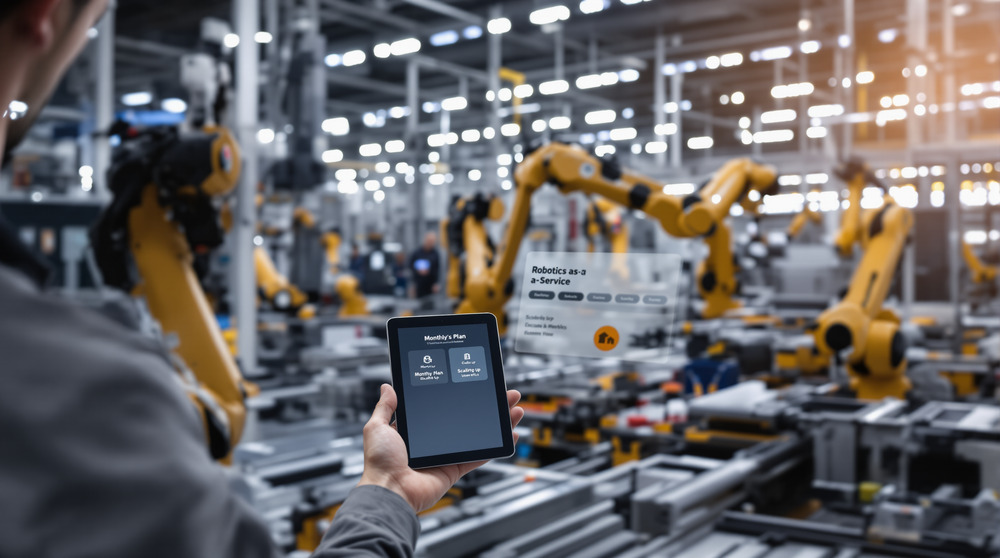
How subscription-based robotics is transforming capital-intensive automation into operational expenses, enabling companies of all sizes to access cutting-edge robotic capabilities
The traditional robotics acquisition model – large capital investments, complex integration projects, and long-term technology risk – has excluded countless organizations from automation benefits. Robotics-as-a-Service (RaaS) fundamentally alters this equation, transforming robotics from a capital expenditure requiring board approval into an operational decision that can be evaluated monthly or quarterly. This shift is democratizing access to advanced automation while creating new opportunities for rapid scaling and technology experimentation.
Early RaaS adopters report compelling advantages: 60-80% reduction in upfront costs, 3-6 month deployment timelines versus 12-24 months for traditional purchases, and built-in upgrade paths that eliminate technology obsolescence risk. More significantly, the subscription model enables companies to scale robotic capabilities dynamically, matching automation investment to business demand in ways that traditional capital purchases cannot achieve.
The RaaS market, valued at $2.8 billion in 2024, is projected to reach $18.4 billion by 2030, driven by SME adoption and enterprise scalability requirements. This growth reflects a fundamental shift in how organizations evaluate and deploy automation, with operating expense models providing financial flexibility that enables broader adoption across industries and company sizes.
Understanding the RaaS Business Model
Financial Structure and Economic Benefits
Robotics-as-a-Service transforms the traditional robotics investment equation from high upfront capital expenditure to predictable monthly operating expenses. Where a typical industrial robot installation might require $200,000-400,000 in capital investment, RaaS models typically involve monthly fees ranging from $2,000-8,000 per robot depending on capability and service level.
This financial restructuring delivers immediate benefits for companies with limited capital availability. Rather than competing with other capital projects for scarce investment dollars, robotics can be evaluated as an operational improvement with immediate impact on productivity and costs. The monthly fee structure also aligns robotics costs with business performance, enabling scaling up during peak periods and reducing costs during slower periods.
Locus Robotics exemplifies successful RaaS implementation in warehouse automation. Their LocusBots are available through subscription models starting at $2,500 monthly per robot, including software, maintenance, and hardware replacement. For a typical 100,000 square foot distribution center, a fleet of 15 robots costs $37,500 monthly versus $450,000 for comparable traditional automation systems.
The economic advantages extend beyond initial costs. RaaS providers handle maintenance, software updates, and hardware replacement through the subscription fee, eliminating unexpected repair costs and technology refresh expenses. Quiet Logistics, an e-commerce fulfillment provider, reports that their Locus Robotics deployment costs 40% less on a total-cost-of-ownership basis compared to traditional automation alternatives when factoring in maintenance, upgrades, and system management costs.
Service Integration and Value-Added Offerings
Leading RaaS providers differentiate themselves through comprehensive service integration that extends beyond equipment provision. These services address the operational challenges that traditionally complicated robotics deployments while creating additional revenue opportunities for service providers.
6 River Systems (acquired by Shopify for $450 million) builds extensive service capabilities into their RaaS offering. Beyond robot provision, they provide workforce training, process optimization consulting, and performance analytics services. This comprehensive approach enables customers to achieve full productivity within 2-3 weeks versus 6-12 weeks for traditional robotics deployments.
The service integration model creates predictable revenue streams while deepening customer relationships. Companies typically expand their robotic deployments by 35-50% annually as they experience productivity benefits, with service providers capturing this growth through subscription model scaling. The recurring relationship also provides opportunities for cross-selling additional automation capabilities as customer needs evolve.
Technology Evolution and Upgrade Pathways
Perhaps the most compelling advantage of RaaS models is built-in technology evolution that eliminates the obsolescence risk inherent in capital robotics purchases. Traditional robot buyers face difficult decisions when new technology emerges: continue operating aging equipment or write off investments for premature upgrades.
RaaS providers address this challenge by incorporating technology upgrades into subscription models. Customers automatically receive hardware and software improvements as they become available, ensuring access to cutting-edge capabilities without additional investment. This approach proves particularly valuable in rapidly evolving fields like computer vision, artificial intelligence, and sensor technology.
Brain Corp’s robotic floor cleaning platform demonstrates this advantage. Their BrainOS-powered cleaning robots receive monthly software updates that improve navigation, cleaning algorithms, and operational efficiency. Customers report 15-20% productivity improvements over 18-month periods purely from software enhancements, improvements that would require equipment replacement under traditional ownership models.
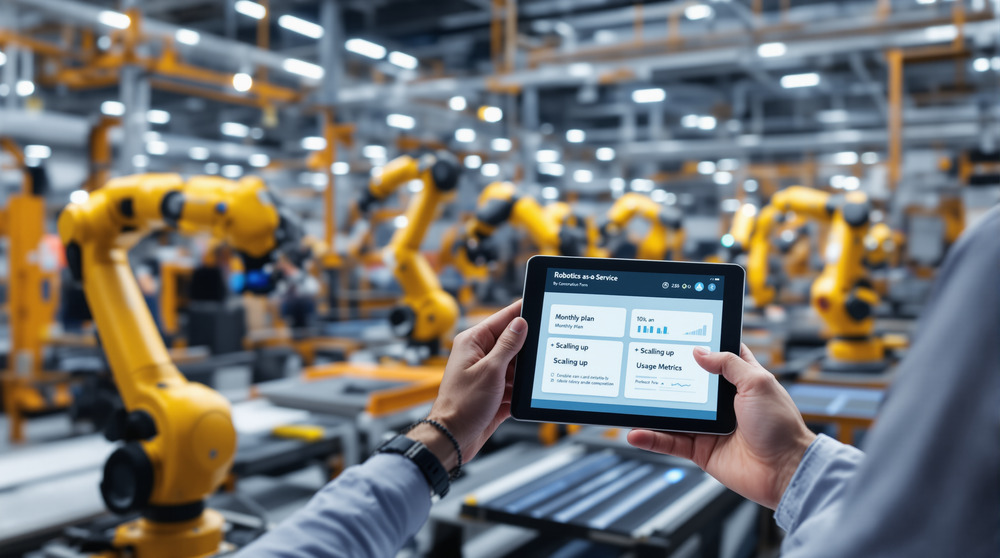
Warehouse Automation: RaaS in Action
Fulfillment Center Transformation
E-commerce fulfillment represents the largest and most mature RaaS market segment, driven by seasonal demand variability and rapid technology evolution that make traditional automation challenging. RaaS models enable fulfillment centers to scale robotic capacity dynamically while accessing continuous technology improvements.
Geek+ (formerly Geek Plus), the world’s largest warehouse robotics provider, has deployed over 20,000 robots through RaaS models across 500+ facilities globally. Their subscription model enables customers to deploy robot fleets within 30 days and scale capacity based on seasonal demand patterns. During peak holiday seasons, customers can increase robotic capacity by 200-300% without capital investment, returning to baseline levels during slower periods.
The economic impact proves substantial for fulfillment operations. Fashion retailer Boohoo implemented Geek+ robots through a RaaS model across their UK distribution centers, achieving 40% productivity improvements while maintaining flexibility to adjust robot counts based on seasonal demand. The company reports that RaaS deployment enabled profitable fulfillment of smaller orders that were previously economically unfeasible.
More significantly, the RaaS model enabled Boohoo to rapidly deploy additional capacity during COVID-19 demand spikes. While competitors struggled with capacity constraints, Boohoo increased robotic capacity by 150% within six weeks, enabling market share capture during a critical period. Traditional automation would have required 12-18 months for comparable capacity expansion.
Last-Mile Delivery Innovation
Last-mile delivery robotics represents an emerging RaaS application where subscription models address the experimental nature of autonomous delivery while providing operational flexibility. Companies can test robotic delivery in specific markets without large capital commitments while scaling successful deployments rapidly.
Starship Technologies has deployed over 4,000 delivery robots through RaaS models across university campuses and urban areas. Their service model charges delivery fees rather than robot lease fees, aligning costs with utilization while handling all maintenance, insurance, and operational management. Universities pay $1.50-2.50 per delivery versus $8-12 for traditional delivery services.
The RaaS approach has enabled rapid geographic expansion that capital-intensive models could not support. Starship operates in over 20 countries with university partners handling minimal upfront investment or operational complexity. The subscription approach also facilitates rapid scaling – new campus deployments can be operational within 2-3 weeks versus 6-12 months for traditional autonomous vehicle programs.
Corporate food service represents another growing RaaS application. Sodexo, the global food service provider, uses Starship robots for corporate campus delivery through a service model that charges per delivery rather than robot ownership. The approach has enabled deployment across 15 corporate campuses while maintaining cost structures that support profitable operations.
Inventory Management and Cycle Counting
Warehouse inventory management represents a high-value RaaS application where robots provide continuous monitoring capabilities that transform inventory accuracy and operational efficiency. Traditional inventory management requires periodic cycle counting that disrupts operations while providing outdated information between counting periods.
Avanade (a joint venture between Accenture and Microsoft) deployed inventory robots from Bossa Nova Robotics through a RaaS model across 50 Walmart stores before the program was discontinued due to COVID-19 operational changes. The robots provided daily inventory scans of 30,000+ SKUs per store, identifying stockouts and pricing errors with 99.7% accuracy.
The RaaS model proved essential for the deployment’s scale and speed. Traditional inventory systems would have required 18-24 months for comparable deployment across 50 locations, while the subscription approach enabled store-by-store rollout over six months. Although Walmart ultimately discontinued the program, the deployment demonstrated RaaS capabilities for rapid scaling of experimental robotics applications.
More successful has been the deployment of inventory robots in distribution centers where controlled environments enable more reliable autonomous operation. Honeywell’s Intelligrated division offers inventory management robots through RaaS models that provide daily cycle counting services for $3,000-5,000 monthly per robot. Customers report 95% reduction in inventory discrepancies while eliminating dedicated cycle counting labor.
Cleaning and Maintenance Applications
Commercial Floor Care Revolution
Robotic floor cleaning represents one of the most successful RaaS applications, driven by labor shortages in commercial cleaning and measurable productivity benefits that justify subscription costs. The predictable nature of cleaning operations enables reliable robot performance while the recurring service need aligns perfectly with subscription business models.
Brain Corp’s BrainOS platform powers robotic floor cleaners from multiple manufacturers including Tennant, Nilfisk, and ICE Cobotics. Their RaaS model provides robots, software, maintenance, and operational support for $800-1,500 monthly per robot depending on facility size and service requirements. Customers report 30-50% reduction in floor cleaning labor costs while achieving superior cleaning consistency.
The Home Depot has deployed over 500 Brain Corp-powered robots across their stores through a RaaS model managed by service provider SoftBank Robotics. The robots handle routine floor cleaning during store hours, enabling human employees to focus on customer service and merchandise management. Home Depot reports 25% improvement in customer satisfaction scores related to store cleanliness while reducing cleaning labor costs by 40%.
The scalability advantages prove particularly valuable for multi-location operations. Walmart deployed autonomous floor cleaners across 1,800+ stores in under 24 months through RaaS partnerships, achieving consistent cleaning standards across all locations while minimizing operational complexity for individual stores. Traditional equipment purchasing would have required extensive procurement processes and local maintenance capabilities that the RaaS model eliminates.
Specialized Cleaning Applications
Beyond floor care, RaaS models enable deployment of specialized cleaning robots for applications where traditional automation would be economically unfeasible. These applications demonstrate how subscription models can make advanced robotics accessible for niche requirements that couldn’t justify capital investment.
Avidbots’ Neo cleaning robots specialize in large facility floor care through RaaS models designed for airports, shopping centers, and industrial facilities. Their subscription service includes robot provision, software updates, maintenance, and operational monitoring for $2,200-3,500 monthly depending on facility requirements. Customers can deploy robots without facility modifications or internal maintenance capabilities.
Pittsburgh International Airport implemented Avidbots robots through their RaaS program, achieving 24/7 cleaning coverage in terminal areas while reducing cleaning labor costs by 35%. The subscription model enabled rapid deployment during COVID-19 when enhanced cleaning protocols required immediate capacity expansion. Traditional procurement would have required 12-18 months versus the 30-day deployment timeline that RaaS enabled.
Hospital cleaning represents another growing RaaS application where specialized requirements justify premium pricing. UVD Robots offers disinfection robots through subscription models that include training, regulatory compliance support, and performance guarantees. Hospitals pay $4,000-6,000 monthly per robot versus $125,000-150,000 for purchase, while receiving guaranteed uptime and efficacy performance.
Strategic Benefits: Beyond Cost Reduction
Operational Flexibility and Demand Matching
RaaS models provide operational flexibility that enables companies to align robotic capacity with business demand dynamically. This capability proves particularly valuable for businesses with seasonal variations, cyclical demand patterns, or uncertain growth trajectories where traditional automation represents excessive fixed cost burden.
Third-party logistics provider Quiet Logistics demonstrates this flexibility through their Locus Robotics deployment. The company operates 200+ robots during peak holiday seasons and scales down to 75 robots during slower periods, adjusting monthly fees accordingly. This demand matching enables profitable operations across seasonal cycles while maintaining service levels that fixed automation systems could not provide cost-effectively.
The flexibility extends to geographic expansion where companies can test new markets with minimal investment while scaling successful operations rapidly. E-commerce retailer Rue21 used RaaS models to deploy robotic fulfillment in new distribution centers, testing market demand before committing to permanent automation investments. Successful locations scaled to full robotic deployment while unsuccessful markets returned equipment without stranded capital.
Risk Mitigation and Technology Experimentation
Traditional robotics investments carry significant technology risk, particularly in rapidly evolving applications like autonomous navigation, computer vision, and artificial intelligence. RaaS models transfer this risk to service providers while enabling customers to experiment with cutting-edge technologies without long-term commitment.
This risk transfer proves particularly valuable for innovative applications where technology maturity remains uncertain. Autonomous delivery, service robotics, and human-robot collaboration represent areas where RaaS enables experimentation that capital purchases would discourage. Companies can test applications for 3-6 months at subscription costs while evaluating business impact before making larger commitments.
The experimentation capability also enables companies to evaluate multiple robotic solutions simultaneously. Rather than selecting single solutions for large-scale deployment, organizations can operate competing technologies in parallel, selecting winners based on actual performance rather than vendor demonstrations. This approach reduces implementation risk while ensuring optimal technology selection.
Access to Expertise and Operational Support
RaaS providers invest heavily in operational expertise that would be difficult for individual customers to develop internally. This expertise includes robot programming, maintenance, troubleshooting, and optimization services that ensure reliable performance while minimizing customer learning curves.
Robotics expertise proves particularly valuable for SMEs lacking internal automation capabilities. RaaS providers offer training, process optimization, and technical support that enable successful deployments without hiring specialized personnel. Customers report 40-60% faster time-to-productivity compared to traditional robotics implementations where internal teams must develop expertise from scratch.
The expertise advantage extends to regulatory compliance and safety management where RaaS providers develop standardized procedures that customers can implement immediately. This capability proves particularly valuable in regulated industries like food processing, pharmaceuticals, and healthcare where compliance requirements would otherwise complicate robotic deployments significantly.
Implementation Considerations and Best Practices
Vendor Selection and Contract Structure
RaaS success depends heavily on vendor selection, with factors extending beyond robot capabilities to include service quality, financial stability, and long-term technology roadmaps. Leading RaaS providers demonstrate strong operational capabilities, comprehensive service offerings, and clear upgrade pathways that ensure customer success throughout subscription periods.
Contract structure requires careful attention to service level agreements, performance guarantees, and termination clauses that protect customer interests while enabling vendor profitability. Successful RaaS contracts specify uptime requirements, response times for technical support, and performance metrics that align vendor incentives with customer success. Clear termination procedures ensure customers can exit agreements if performance expectations are not met.
Financial terms should address scaling provisions, seasonal adjustments, and technology upgrade pathways that enable business growth while controlling costs. Leading contracts include provisions for capacity scaling, geographic expansion, and early termination that provide operational flexibility throughout subscription periods.
Integration and Change Management
Despite reduced capital requirements, RaaS deployments require careful integration planning and change management to ensure successful adoption. Organizations must address workflow changes, employee training, and operational procedures that enable effective human-robot collaboration throughout deployment periods.
Successful RaaS implementations typically involve pilot programs that demonstrate value while building internal expertise and confidence. These pilots enable organizations to optimize processes and train personnel before full-scale deployment while providing opportunities to adjust vendor relationships based on actual experience. Leading companies report that pilot programs reduce deployment risk while accelerating full-scale implementation.
Change management proves particularly critical for RaaS deployments where subscription costs create ongoing budget commitments. Organizations must demonstrate consistent value delivery to maintain management support while ensuring employee adoption that enables projected productivity benefits. Clear communication about robotics goals and employee impact helps maintain support throughout deployment periods.
Performance Measurement and Optimization
RaaS models require robust performance measurement systems that demonstrate value delivery and identify optimization opportunities throughout subscription periods. Unlike capital equipment where performance evaluation occurs primarily during purchase decisions, subscription models require ongoing value demonstration to justify continued investment.
Leading RaaS deployments implement comprehensive metrics covering productivity, quality, cost, and operational efficiency that enable continuous optimization. These metrics should align with business objectives while providing data for vendor performance evaluation and contract negotiation. Regular performance reviews ensure that RaaS deployments continue delivering expected value while identifying opportunities for capacity expansion or service enhancement.
The subscription model also enables experimentation with different operational approaches, robot configurations, and process optimizations that would be difficult to implement with owned equipment. Organizations can request vendor modifications, test new capabilities, and optimize operations continuously rather than accepting fixed configurations that traditional purchases require.
Robotics-as-a-Service represents a fundamental shift in automation adoption that eliminates traditional barriers while creating new opportunities for operational excellence. Organizations that embrace RaaS strategically will access advanced robotic capabilities while maintaining financial flexibility and technology currency that traditional ownership models cannot provide. The question for business leaders is not whether subscription models will reshape robotics adoption, but how quickly they can develop capabilities to leverage this transformational approach to automation investment.
About The Author