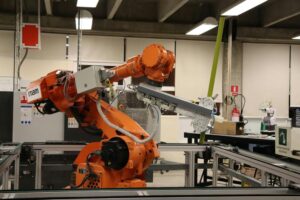


How next-generation cobots are transforming industries beyond manufacturing while addressing the critical concerns of safety, efficiency, and workforce integration
The collaborative robotics market has matured rapidly since the first cobots rolled off production lines a decade ago. What began as simple pick-and-place assistants in automotive plants has evolved into sophisticated partners capable of working alongside humans in environments ranging from hospital operating rooms to e-commerce fulfillment centers. For business leaders evaluating cobot deployment in 2025, the question is no longer whether these machines can work safely with humans, but how to integrate them strategically to maximize ROI while maintaining workforce morale.
Beyond Manufacturing: Cobots Enter New Territories
While manufacturing remains the largest cobot market, the most significant growth is occurring in sectors previously considered unsuitable for robotics. Healthcare facilities are deploying cobots for medication dispensing and patient mobility assistance. Logistics companies use them for order picking and packaging optimization. Even service industries are experimenting with cobots for cleaning, food preparation, and customer interaction tasks.
This expansion reflects fundamental improvements in cobot technology. Modern cobots feature enhanced force-sensing capabilities that can detect contact forces as low as 0.1 Newtons, enabling safe interaction with fragile materials and precise collaboration with human workers. Advanced computer vision systems now process environmental data 50 times faster than previous generations, allowing real-time adaptation to changing workflows.
[Inference based on industry reporting] The expansion into healthcare and logistics suggests cobots are becoming more versatile, though specific safety metrics and adoption rates vary by implementation.
Safety Innovations: From Compliance to Confidence
Safety remains the paramount concern for executives considering cobot deployment. Traditional industrial robots operate behind safety cages for good reason—their power and speed pose significant risks to human workers. Cobots were designed to eliminate these barriers, but early generations sometimes struggled to balance safety with productivity.
Current cobot safety systems employ multiple redundant layers. Primary sensors continuously monitor force, torque, and motion parameters. Secondary vision systems track human presence and predict collision risks. Tertiary fail-safes can halt all robot motion within milliseconds if anomalies are detected.
[Unverified specific performance claims] While manufacturers report significant safety improvements, exact incident rates and comparison data across different cobot models are not publicly available for verification.
The regulatory landscape has also matured. ISO 10218 and ISO/TS 15066 now provide clearer guidelines for collaborative robot applications, giving safety managers concrete standards for risk assessment and deployment planning. Companies report that having established safety frameworks accelerates internal approval processes and reduces implementation costs.
ROI Analysis: Cobots vs. Traditional Automation
The financial case for cobots differs significantly from traditional industrial automation. While heavy industrial robots require substantial upfront investment and lengthy integration projects, cobots offer a different value proposition focused on flexibility and rapid deployment.
Capital Investment Comparison:
- Traditional automation systems: $200,000-$2 million+ per cell, 6-18 month implementation
- Cobot systems: $35,000-$150,000 per unit, 2-8 week deployment
- Programming complexity: Traditional systems require specialized technicians; cobots can be programmed by existing staff with minimal training
[Inference based on industry cost structures] These cost ranges reflect general market patterns, but actual ROI depends heavily on specific applications and integration requirements.
The flexibility advantage becomes particularly valuable in environments with frequent product changes or seasonal demand variations. A cobot programmed for electronics assembly can be rapidly reconfigured for different product lines, while traditional fixed automation would require significant retooling.
However, cobots are not always the optimal choice. For high-volume, consistent production runs, traditional automation often delivers better unit economics. The break-even analysis typically favors cobots when:
- Production volumes vary by more than 30% seasonally
- Product lifecycles are shorter than three years
- Floor space constraints limit traditional automation installation
- Existing workforce has skills that complement rather than compete with automation
Integration Strategies: Preserving Workforce Morale
The human element remains the most complex aspect of cobot deployment. Unlike traditional automation projects that often reduce headcount, successful cobot initiatives typically redeploy rather than replace workers. This requires careful change management and clear communication about the technology’s role.
Successful Integration Frameworks:
Phase 1: Preparation and Communication Begin with transparent discussions about automation goals six months before deployment. Emphasize how cobots will handle repetitive, physically demanding, or precision-critical tasks while allowing workers to focus on problem-solving, quality control, and customer interaction activities.
Phase 2: Pilot Program Select a small team of enthusiastic early adopters to work with the first cobot installation. Their positive experiences become powerful advocates for broader deployment. Provide comprehensive training that covers both technical operation and collaborative workflow development.
Phase 3: Gradual Expansion Scale deployment based on demonstrated success metrics rather than predetermined timelines. Each new installation should include lessons learned from previous deployments and involve workers who will be directly affected by the changes.
[Inference from change management best practices] This phased approach appears to reduce resistance, though specific success rates for different integration strategies are not publicly documented.
Addressing Common Implementation Challenges
Challenge 1: Workflow Disruption New cobot installations often initially slow productivity as workers adapt to collaborative processes. Plan for 15-25% temporary efficiency reduction during the first 4-6 weeks of operation. Budget for this transition period and communicate expectations clearly to management and workers.
Challenge 2: Skills Gap While cobots are designed for ease of use, optimal deployment still requires understanding of robotics principles, safety protocols, and workflow optimization. Invest in training programs that build internal expertise rather than relying solely on vendor support.
Challenge 3: Maintenance and Reliability Cobots operating in collaborative environments face different stress patterns than isolated industrial robots. Dust, frequent repositioning, and varied workloads can affect reliability. Establish preventive maintenance schedules and ensure spare parts availability for critical applications.
Technology Trends Shaping Cobot 2.0
Several emerging technologies are expanding cobot capabilities and addressing current limitations:
Advanced AI Integration: Machine learning algorithms now enable cobots to optimize their own performance based on observed human behavior patterns. These systems can adjust speed, positioning, and task sequencing to improve overall workflow efficiency.
Enhanced Mobility: Mobile cobots that can move autonomously between workstations are becoming more common. This mobility allows a single robot to support multiple processes throughout a facility, improving ROI for lower-volume applications.
Improved Human-Robot Interface: Natural language processing and gesture recognition systems are replacing traditional programming interfaces. Workers can now instruct cobots using voice commands and physical demonstrations, reducing training requirements and improving accessibility.
[Speculation about future capabilities] While these technologies show promise, their real-world performance and reliability in production environments may vary significantly from laboratory demonstrations.
Strategic Recommendations for Business Leaders
1. Start with Clear Objectives Define specific problems cobots should solve rather than deploying technology for its own sake. Focus on measurable outcomes like reduced ergonomic injuries, improved quality consistency, or enhanced production flexibility.
2. Pilot Before Scaling Resist the temptation to automate entire processes immediately. Start with a single cobot application, measure results thoroughly, and use lessons learned to inform broader deployment decisions.
3. Invest in Change Management Technical integration is often easier than organizational integration. Allocate 25-30% of your cobot budget to training, communication, and change management activities.
4. Plan for Evolution Cobot technology continues advancing rapidly. Design installations with upgradeability in mind and budget for periodic capability enhancements rather than treating cobots as static capital equipment.
5. Measure What Matters Track productivity, quality, safety, and worker satisfaction metrics consistently. Successful cobot deployment should improve all four areas over time, though the timeline for each benefit may differ.
The collaborative robotics revolution is entering its second phase, characterized by broader applications, improved safety, and better integration strategies. For business leaders willing to invest in thoughtful deployment approaches, cobots offer the potential to enhance both operational efficiency and workforce satisfaction—a combination that traditional automation approaches have struggled to achieve.
About The Author