
Understanding the complex algorithms and emergent behaviors that enable hundreds of simple robots to solve problems no single robot could tackle alone
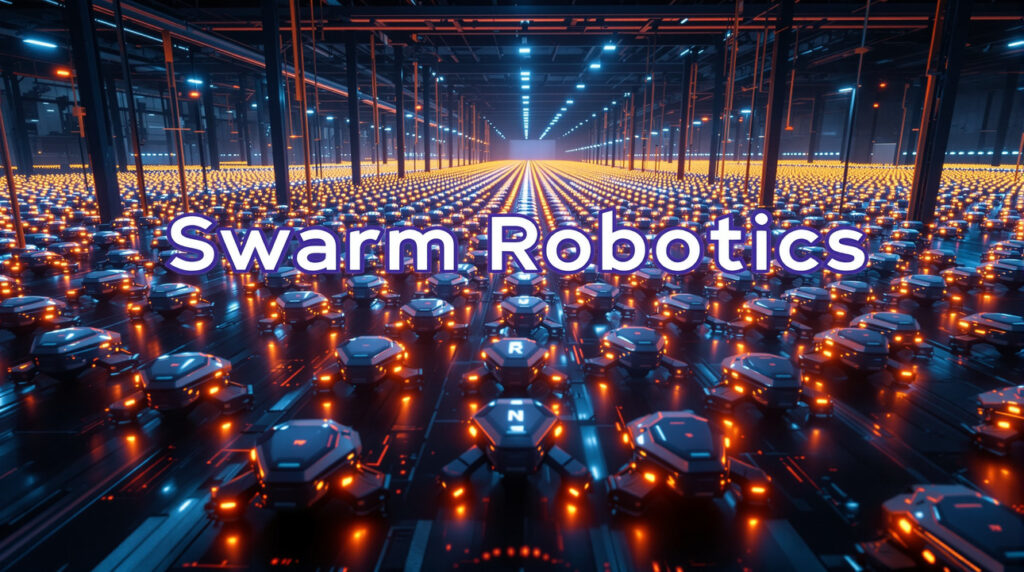
Imagine a warehouse where hundreds of small, seemingly simple robots work together like a colony of ants, automatically organizing inventory, optimizing pathways, and adapting to disruptions without any central command structure. This isn’t science fiction—it’s swarm robotics, one of the most transformative technologies reshaping industrial automation today.
What is Swarm Robotics?
Swarm robotics represents a fundamental shift from traditional single-robot systems to distributed networks of autonomous agents that exhibit collective intelligence. Unlike conventional industrial robots that rely on centralized control systems, swarm robots operate through decentralized decision-making, where individual robots follow simple rules that generate complex, coordinated behaviors at the system level.
The concept draws inspiration from nature’s most successful collective systems: ant colonies, bee swarms, and flocks of birds. These biological systems demonstrate how simple individuals, following basic local rules, can achieve sophisticated group behaviors without centralized coordination.
The Core Principles of Swarm Intelligence
1. Emergence: The Whole Greater Than Its Parts
Emergence is the cornerstone of swarm robotics. When individual robots follow simple behavioral rules—such as “maintain distance from neighbors” or “move toward the average position of nearby robots”—the collective system exhibits intelligent behaviors that no single robot possesses.
For example, in a warehouse swarm system, each robot might follow these basic rules:
- Move toward items that need collection
- Avoid collisions with other robots
- Share location data with nearby robots
- Return to charging stations when battery is low
From these simple rules emerges a sophisticated logistics system capable of dynamic load balancing, automatic route optimization, and self-healing when individual robots fail.
2. Decentralized Decision Making
Traditional robotic systems rely on a central controller that processes information and issues commands to individual robots. Swarm systems flip this model: each robot makes autonomous decisions based on local information and simple communication with nearby neighbors.
This decentralization provides several critical advantages:
- Scalability: Adding more robots doesn’t create communication bottlenecks
- Robustness: System continues functioning even if individual robots fail
- Adaptability: Swarm responds dynamically to changing conditions without reprogramming
3. Local Communication and Global Coordination
Swarm robots achieve global coordination through local communication protocols. Each robot only needs to communicate with its immediate neighbors, yet the entire swarm maintains coherent behavior through information cascading across the network.
Think of it like a crowd navigating through a building during an emergency: individuals only see their immediate surroundings and communicate with nearby people, yet the entire crowd can efficiently evacuate through emergent path-finding behavior.
The Technical Architecture
Communication Protocols
Swarm robots typically use lightweight communication protocols designed for rapid, local information exchange:
Stigmergy: Indirect communication through environmental modification, similar to how ants leave pheromone trails. In robotics, this might involve robots leaving digital markers in shared databases or physical environment modifications.
Direct Communication: Short-range wireless protocols (WiFi, Bluetooth, or specialized mesh networks) for sharing position data, task status, and local environmental information.
Consensus Algorithms: Mathematical protocols ensuring all robots eventually agree on shared information despite communication delays and network partitions.
Behavioral Algorithms
The intelligence of swarm systems emerges from carefully designed algorithms governing individual robot behavior:
Flocking Algorithms: Based on three simple rules—separation (avoid crowding), alignment (steer toward average heading of neighbors), and cohesion (move toward average position of neighbors). These create coordinated group movement.
Ant Colony Optimization: Robots strengthen digital “pheromone trails” for successful paths while unsuccessful paths fade over time, automatically optimizing route selection across the swarm.
Particle Swarm Optimization: Each robot adjusts its behavior based on its own experience and the best performance of its neighbors, leading to system-wide optimization of objectives like energy efficiency or task completion time.
Fault Tolerance and Self-Healing
One of swarm robotics’ most powerful features is its inherent fault tolerance. When individual robots fail, the remaining swarm automatically compensates through several mechanisms:
Load Redistribution: Tasks assigned to failed robots are automatically picked up by neighboring robots through local negotiation protocols.
Route Reoptimization: The swarm discovers new optimal paths around failed robots or obstacles without central replanning.
Redundancy: Multiple robots can perform similar functions, so individual failures don’t compromise overall mission success.
Real-World Applications Transforming Industries
Warehouse Automation: The Kiva Revolution
Amazon’s acquisition of Kiva Systems (now Amazon Robotics) demonstrated swarm robotics’ commercial potential. Thousands of small robots work together to move inventory shelves to human workers, reducing walking time and increasing picking efficiency by up to 50%. The system’s swarm intelligence automatically optimizes traffic flow, prevents congestions, and adapts to changing product demand patterns.
Manufacturing: Flexible Production Lines
BMW and other automotive manufacturers are deploying swarm robotic systems for flexible assembly line operations. Small, mobile robots can reconfigure themselves into different formations for various assembly tasks, eliminating the need for fixed conveyor systems and enabling rapid production line reconfiguration for different vehicle models.
Agriculture: Precision Farming at Scale
Agricultural swarm systems deploy hundreds of small robots across large fields for precision planting, weeding, and harvesting. Each robot handles a small area while the swarm coordinates to ensure complete field coverage, optimize resource usage, and adapt to varying soil conditions and crop densities.
Construction: Autonomous Building Assembly
Research initiatives are developing construction swarms inspired by termite mound building. Small robots work collectively to assemble structures by following simple rules about material placement, potentially enabling automated construction in hazardous environments or remote locations.
The Technical Challenges
Scalability Complexity
While swarm systems theoretically scale better than centralized systems, practical challenges emerge as swarm size increases:
Communication Bandwidth: Even with local communication, large swarms can saturate wireless channels, requiring sophisticated frequency management and protocol optimization.
Computational Complexity: Behavioral algorithms that work well for dozens of robots may exhibit unexpected behaviors or performance degradation when scaled to hundreds or thousands of units.
Coordination Delays: Information propagation across large swarms takes time, potentially leading to suboptimal decisions based on outdated information.
Environmental Uncertainty
Real-world environments present challenges not found in controlled laboratory conditions:
Dynamic Obstacles: Humans, equipment, and changing environmental conditions require robust obstacle avoidance algorithms that don’t disrupt swarm coordination.
Sensor Limitations: Individual robots typically use low-cost sensors with limited range and accuracy, requiring sophisticated sensor fusion algorithms to maintain situational awareness.
Network Partitions: Physical obstacles or interference can split the swarm into isolated subgroups, requiring algorithms to maintain coordination across network partitions and merge behaviors when connectivity is restored.
Security and Safety
Distributed systems present unique security challenges:
Byzantine Fault Tolerance: Swarms must continue operating correctly even when some robots are compromised or provide false information.
Emergence Verification: Ensuring that emergent behaviors remain safe and predictable as system parameters change or environments evolve.
Human-Swarm Interaction: Developing safe protocols for humans working alongside robot swarms, including emergency stop procedures and predictable swarm behaviors.
The Economic Impact and ROI
Operational Efficiency Gains
Organizations deploying swarm robotics report significant operational improvements:
Labor Cost Reduction: Swarm systems can operate 24/7 without breaks, reducing labor costs by 40-60% in many applications while improving consistency and accuracy.
Energy Efficiency: Distributed task allocation and optimized pathfinding reduce overall energy consumption compared to traditional centralized systems.
Maintenance Cost Reduction: Fault tolerance and self-healing capabilities reduce downtime and maintenance requirements, with some systems reporting 90% uptime compared to 70-80% for traditional robotic systems.
Capital Investment Considerations
Lower Individual Unit Costs: Swarm robots are typically simpler and less expensive than traditional industrial robots, with costs often 50-70% lower per unit of capability.
Incremental Deployment: Organizations can start with small swarms and gradually scale up, spreading capital investment over time and proving ROI before major commitments.
Reduced Infrastructure Requirements: Swarm systems often require less fixed infrastructure than traditional automation, reducing facility modification costs.
Future Developments and Trends
AI Integration and Learning Swarms
The next generation of swarm robotics will incorporate machine learning and artificial intelligence:
Adaptive Algorithms: Swarms that learn from experience and automatically optimize their behavioral rules for specific environments and tasks.
Predictive Coordination: AI-powered systems that anticipate future conditions and preemptively adjust swarm behavior to maintain optimal performance.
Cross-Domain Learning: Swarms that transfer learned behaviors between different applications and environments.
Human-Swarm Collaboration
Developing intuitive interfaces for human operators to direct and collaborate with robot swarms:
Gesture-Based Control: Natural user interfaces allowing operators to guide swarm behavior through gestures and voice commands.
Augmented Reality Integration: AR systems providing operators with real-time visualization of swarm status, intentions, and performance metrics.
Collaborative Task Allocation: Systems where humans and robots dynamically negotiate task assignments based on respective capabilities and current conditions.
Implementation Strategy for Organizations
Assessment and Planning
Organizations considering swarm robotics should begin with thorough assessment:
Task Suitability Analysis: Identifying which operations would benefit most from distributed, fault-tolerant automation.
Infrastructure Evaluation: Assessing existing facilities and systems for swarm robotics compatibility.
ROI Modeling: Developing detailed financial models incorporating both direct costs and indirect benefits like improved flexibility and reduced downtime.
Pilot Program Development
Start Small: Beginning with limited-scope pilot programs to validate assumptions and build organizational expertise.
Integration Planning: Developing strategies for integrating swarm systems with existing enterprise systems and workflows.
Training and Change Management: Preparing workforce for collaboration with swarm robotic systems and developing new operational procedures.
Conclusion: The Swarm Advantage
Swarm robotics represents more than an incremental improvement in automation technology—it’s a fundamentally new approach to solving complex industrial challenges. By harnessing the power of collective intelligence, organizations can achieve levels of flexibility, robustness, and efficiency that were previously impossible with traditional robotic systems.
The key to successful swarm robotics implementation lies in understanding that the system’s intelligence emerges from the interactions between simple components, not from the sophistication of individual robots. This paradigm shift requires new ways of thinking about automation design, but the rewards—including dramatic improvements in operational efficiency, cost reduction, and system reliability—make swarm robotics one of the most promising technologies for the future of industrial automation.
As swarm robotics technology continues to mature and costs decrease, we can expect to see rapid adoption across industries. Organizations that begin exploring and implementing these systems today will be best positioned to leverage their transformative potential as the technology reaches full commercial maturity.
I
About The Author